Conductor condition
Use winding-resistance measurements with the required compensation, phase comparison, connection quality, and acceptance basis.


Motor winding guide
Choose winding tests by the fault mechanism and decision required, then confirm the method sequence, limits, equipment, records, and support fit.
Application overview
Winding resistance, insulation resistance, and surge testing evaluate different parts of winding condition. Other electrical or functional methods may belong in the same process when the motor, winding, production stage, or service decision requires them.
No single reading establishes complete motor condition. A useful plan identifies the likely fault mechanisms, applicable requirements, comparison basis, test sequence, limits, and action tied to each result.
Review the Schleich motors and windings rangeRecovered catalog context
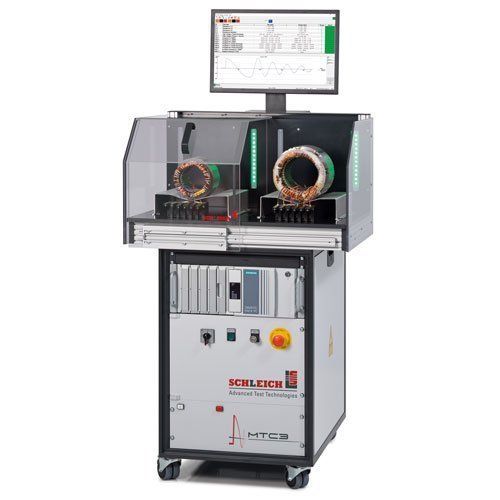
The captured MTC3 catalog described a modular winding-test system that could combine winding, safety, and functional methods in one configured cabinet.
It also described automatic test-step switching, evaluation of individual steps, reproducible pass or fail output, and manual, semi-automatic, or automatic inspection. Those are historical catalog statements, so current method options and configuration still require confirmation.
System scope
A useful specification connects the checks being performed to the equipment, process, interfaces, results, and people responsible for the work.
Use winding-resistance measurements with the required compensation, phase comparison, connection quality, and acceptance basis.
Use insulation-resistance and related methods within the applicable procedure, environmental context, limits, and comparison basis.
Use surge testing when the winding and applicable procedure support it, with the required voltage, comparison, evaluation, and safety controls.
Application workflow
Use these steps to turn a broad application request into a current technical and support conversation.
Record the winding type, ratings, construction, production or service stage, symptoms, history, and decision the results must support.
Separate conductor, ground-wall insulation, turn-insulation, and functional questions before choosing a test sequence.
Define corrections, baselines, phase comparisons, applicable requirements, acceptance logic, and the action tied to an abnormal result.
Review current equipment fit, configuration, fixtures, automation, result handling, documentation, training, and service with MDS.
Prepare for review
These inputs help MDS identify the right current product, test method, system, and support path without treating a general guide as a final specification.
Current next step
Share the equipment, process, test objective, interfaces, documentation needs, and support expectations so MDS can confirm the current fit.